Ingence on the BioImage Archive#
This page shows what Ingence made of 263 studies in the BioImage Archive. It read each study’s list of files, downloaded none of the files, and proposed which files belong together. The names, accession numbers and counts are the archive’s and the engine’s, taken from one stored run made on 13 October 2026. A later version of Ingence, or a later copy of the archive, will give other numbers.
The archive’s data is public, so this page uses its real study numbers (accessions) and file names. For the mechanism behind reading an archive, see Public archives.
What was read#
263 studies. Together they list 194,745 files in 15,850 folders, counting each study’s top folder. The files declare 68.6 terabytes in all. The largest study lists 9,224 files (S-BIAD1217), nine studies list a single file (one is S-BIAD1304), and the middle study lists 90.
What a listing holds. For each file: its path, its declared size, the address where the archive keeps it, and the labels the depositor wrote for it, such as a genotype, a channel or the dataset it belongs to. A study’s listing also holds its title, where the depositor gave one.
What a listing does not hold. It holds no file contents. No file in these listings has a modification date. A checksum label appears on 87 of the 194,745 files, in two studies. The only dates Ingence has are dates written in names: 30,839 of the 210,595 files and folders have one.
What was not done. No file was opened or downloaded, and no depositor’s file was changed. The engine never writes into the place it reads.
Applying the rules to all 263 studies with infer took 21 minutes on one laptop. A single study
took seconds.
One study, read in detail#
The study is S-BIAD2122, “eIF2A regulates cell migration in a translation-independent manner” (released 30 June 2025). It lists 38 files in 18 folders, 10.7 gigabytes declared. It was chosen because its names carry two conditions, several stains and two cell lines, and because it is small enough to read whole.
Its folders#
eif2A_raw_microscopy/
  Fig6A/lifext_files/     9 files
  Fig7G/                  8 files
melstr_confocal/
  Fig5C/lif_files/        1 file
  Fig5C/lifext_files/     1 file
  Fig6A/lif_files/        9 files
uacc_confocal2/
  Fig6C/lif_files/        7 files
  Fig6C/lifext_files/     1 file
  Fig7E/lif_files/        1 file
  Fig7E/lifext_files/     1 file
A few of the file names:
Fig_6A_MelSTR_shCTL_30_min_4.lifext
Fig_6A_MelSTR_shEIF_30_min_CEP_GM_2.lif
Fig_7G_r03c04-UACC62_shCTL_BICD2-sk1fk1fl1.tiff
Fig6C_UACC62_shCTL_shEIF_eIF_peri_3.lif
Fig7E_UACC_recons_PFA_p3_PCNT_eIF.lifext
The files are in three formats: 18 .lif, 12 .lifext and 8 .tiff.
How the engine read the names#
Ingence cuts each name into pieces: words, numbers, the extension and amounts with a unit. It looks each word up in the Dictionary, the list of what words mean. A word the Dictionary has no entry for is examined, no evidence. A word with two or more meanings and nothing to choose between them is examined, conflicting. Neither is a guess.
The 38 names were cut into 369 pieces. Of its 234 words, 53 had a meaning, 163 none and 18 two or more. The other pieces are numbers, extensions and amounts with a unit.
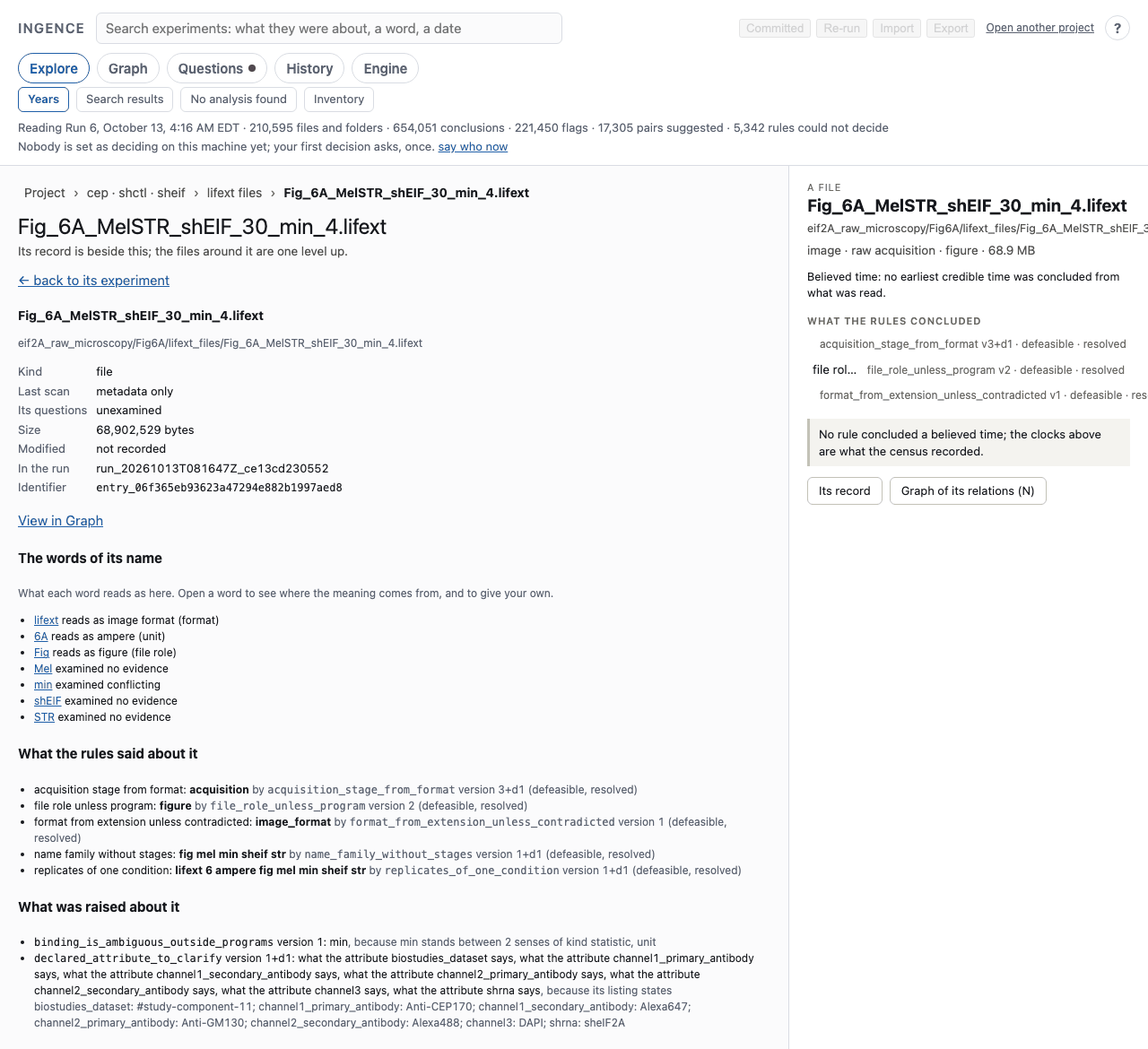
One file’s record in the Dashboard: how each word of its name was read, and which rules concluded what, each with its version. Select the picture to see it at full size.#
For Fig_6A_MelSTR_shEIF_30_min_4.lifext the readings are:
Piece |
Reading |
|---|---|
Fig |
figure, a purpose a file’s name can state |
6A |
6 amperes, a unit (a wrong reading, see below) |
Mel, STR |
no evidence |
shEIF |
no evidence |
min |
conflicting: the minimum, or minutes |
lifext |
an image format |
Words the Dictionary knew in this study: Fig, the formats lif, lifext and tiff, confocal, PFA and the passage mark p3. Words it did not know include shCTL, shEIF, MelSTR, UACC62, eIF2A, CEP170, PCNT and pericentrin: a knockdown, a cell line and proteins, which the depositor’s labels name and the Dictionary does not.
What the rules proposed#
Each conclusion comes from a named rule with a version. Each name links to the rule’s page.
format_from_extension_unless_contradicted, version1: an image format, for all 38 files.acquisition_stage_from_format, version3+d1: raw data from the instrument (“acquisition”), for the 30.lifand.lifextfiles.file_role_unless_program, version2: “figure”, for 28 files whose names hold the word Fig.name_family_without_stages, version1+d1: 8 families of names that share every word, holding 25 of the 38 files.replicates_of_one_condition, version1+d1: 8 sets of repeats of one condition, holding 18 files.experiment_folder_from_contents, version3: 5 experiments, each a folder of one session’s raw files, holding 30 files.
Three things in these results show what the rules did with the names:
Conditions stayed apart. The names with shCTL and the names with shEIF fell in different families, and the names with CEP_GM fell apart from those without.
A format twin joined its family. A
.liffile and the.lifextfile with the same name are in one family. The engine proposes the family and does not say the two are copies.A one-character difference kept a file out.
Fig_6A_MelSTR_shEIF6_30_min_CEP_GM_1.lifis probably a typing slip, since the depositor labels it as the same knockdown. Its name has the word shEIF6, so it is in no family.
The 5 experiments hold exactly the 30 raw files. The line of work they form is shown under Across studies.
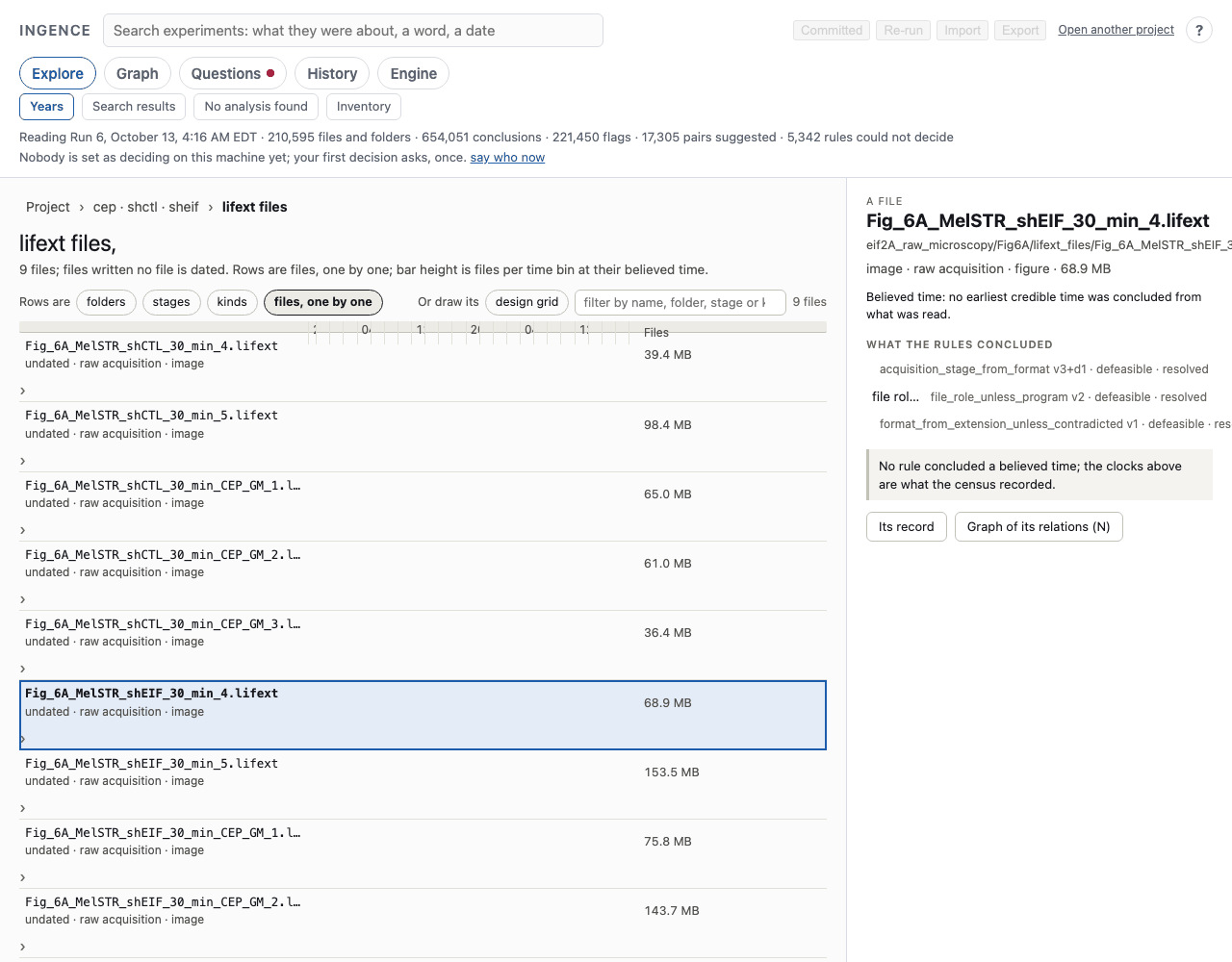
The nine files of one of the study’s experiments, the folder of .lifext files for Figure 6A. Select the picture to see it at full size.#
What it left out, and what it got wrong#
The 8
.tifffiles in Fig7G. They are in no family, no experiment and no stage. The stage rule covers formats an instrument writes, and the extension alone does not say a.tiffis one.5 more files in no family: 4 in Fig6C, and the shEIF6 file above. No other file shares all of their words.
10 files not read as “figure”. The files in Fig6C and Fig7E write the figure and the panel as one word (Fig6C), which the Dictionary does not have.
Dates. No file has a date, so the 5 experiments have none either.
Contents. Nothing about what is inside a file, since the listing has none.
No derivation. The engine proposed no file as made from another in this study.
Wrong readings. A figure panel such as 6A was read as 6 amperes (18 files), 5C as 5 degrees Celsius (2 files), and GM, written for the Golgi marker GM130, as grams (10 files). These readings are wrong. The families and sets above still follow the names.
Questions raised. For each of the 38 files, the engine raised one question listing that file’s labels from the depositor, and it flagged the word min as having two meanings.
What the depositor declared#
The listing also holds the archive’s own division of these files into datasets, in three groups: 20 files under “#study-component-11”, 10 under “Confocal imaging UACC cell lines” and 8 under “Confocal imaging MelSTR cell lines”. No rule groups files by this label. It is recorded beside the names, so a person can compare.
The comparison here: the engine’s 5 experiments fall inside the first two datasets. The third dataset,
the 8 .tiff files of Fig7G, is the part of the study the engine did not propose as an experiment or a
family.
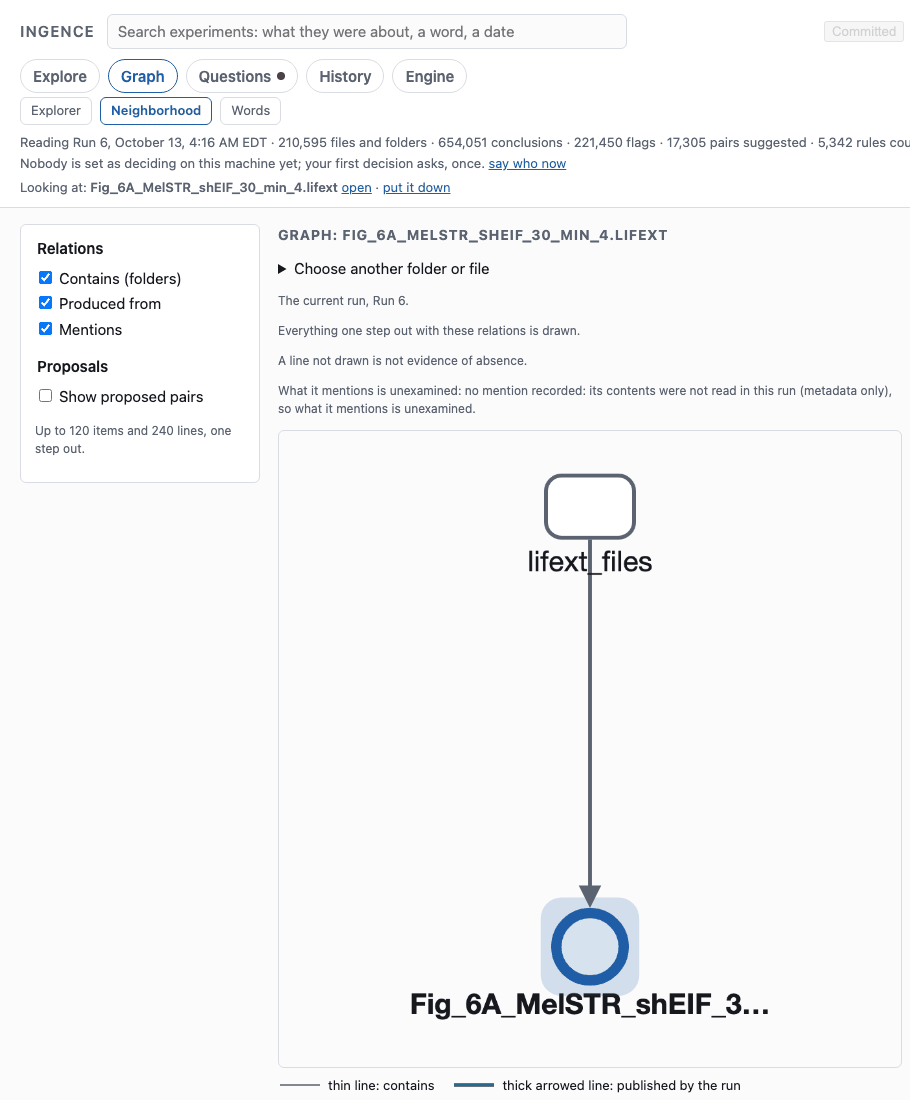
The Graph around one file. Only the folder holds it: the engine found no file that it was made from. Select the picture to see it at full size.#
Open the same study yourself#
ingence init study --root listing:biostudies:S-BIAD2122 --all-domains
--all-domains loads every shipped pack of words, as the stored run did.
Then read the study and look at it:
ingence index -p study --fetch
ingence infer -p study
ingence see -p study
index --fetch is the one step that needs the network. It fetches this study’s list of files only. A project
with this one study gives the same 5 experiments, 8 families and 8 sets of repeats as above, when
given the stored listing. A listing fetched later may differ in the labels it carries, and the archive
may have changed the study.
Without --all-domains, a project starts with one pack, and infer ends by proposing the microscopy
pack for you to accept. Fewer names are understood until it is loaded.
Across studies#
All 263 studies were read as one project. The Dashboard’s first page shows them by year.
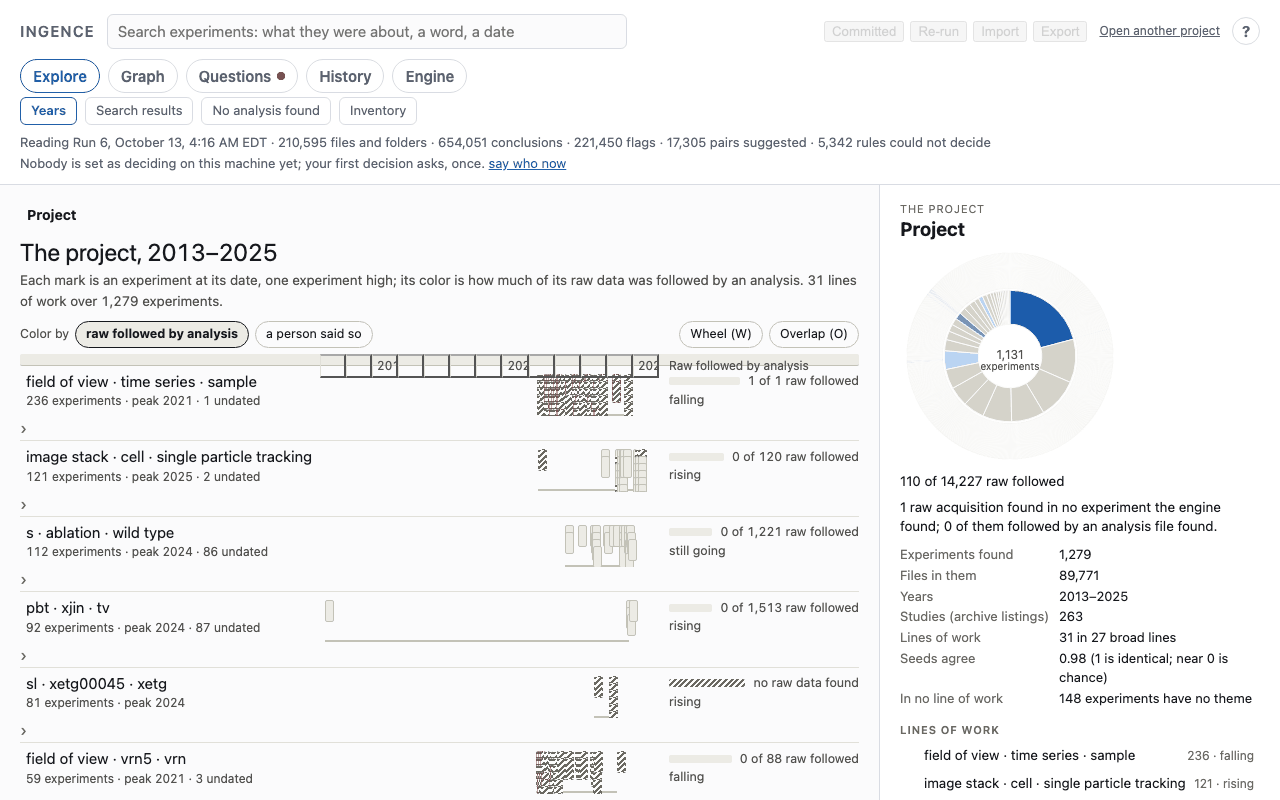
The Years page at the scale of the whole project: 1,279 experiments in 31 lines of work. Select the picture to see it at full size.#
Experiments#
The engine proposed 1,279 experiments in 96 of the 263 studies, holding 89,771 of the 194,745 files. In the other 167 studies it proposed none. An experiment here is a folder that its contents or its dated name mark as one. It also proposed 17,305 pairs of files that may be related, 10,474 of them with a direction, one suggested as made from the other. These are proposals for a person to check.
Lines of work#
A line of work is a set of experiments whose names share words. The engine found 31, holding 1,131 of the 1,279 experiments. A line is named by its three heaviest words, the three that weigh most in the experiments’ names. These are eight of them:
Line of work |
Experiments |
Studies |
Largest share in one study |
|---|---|---|---|
airyscan, a, cpk |
52 |
12 |
S-BIAD1733 (13) |
s, ablation, wild type |
112 |
11 |
S-BIAD1521 (77) |
gain, cd, file |
55 |
7 |
S-BIAD1761 (26) |
field of view, vrn5, vrn |
59 |
5 |
S-BIAD1217 (44) |
differential interference contrast, fluorescent protein, seq |
55 |
3 |
S-BIAD2192 (41) |
knockout, neun, gde |
19 |
1 |
S-BIAD1153 (19) |
fgf, nuclear stain, blastema |
18 |
1 |
S-BIAD2250 (18) |
cep, shctl, sheif |
5 |
1 |
S-BIAD2122 (5) |
Most lines are one study’s own work. In 16 of the 31, every experiment is in one study. The line that crosses the most studies is the first, with experiments in 12. A line’s words are a mix of Dictionary meanings (airyscan, knockout, nuclear stain) and words the Dictionary does not know, which are often a laboratory’s own abbreviations (cpk, vrn5). The last line is the study read above, whose 5 experiments are all of its experiments.
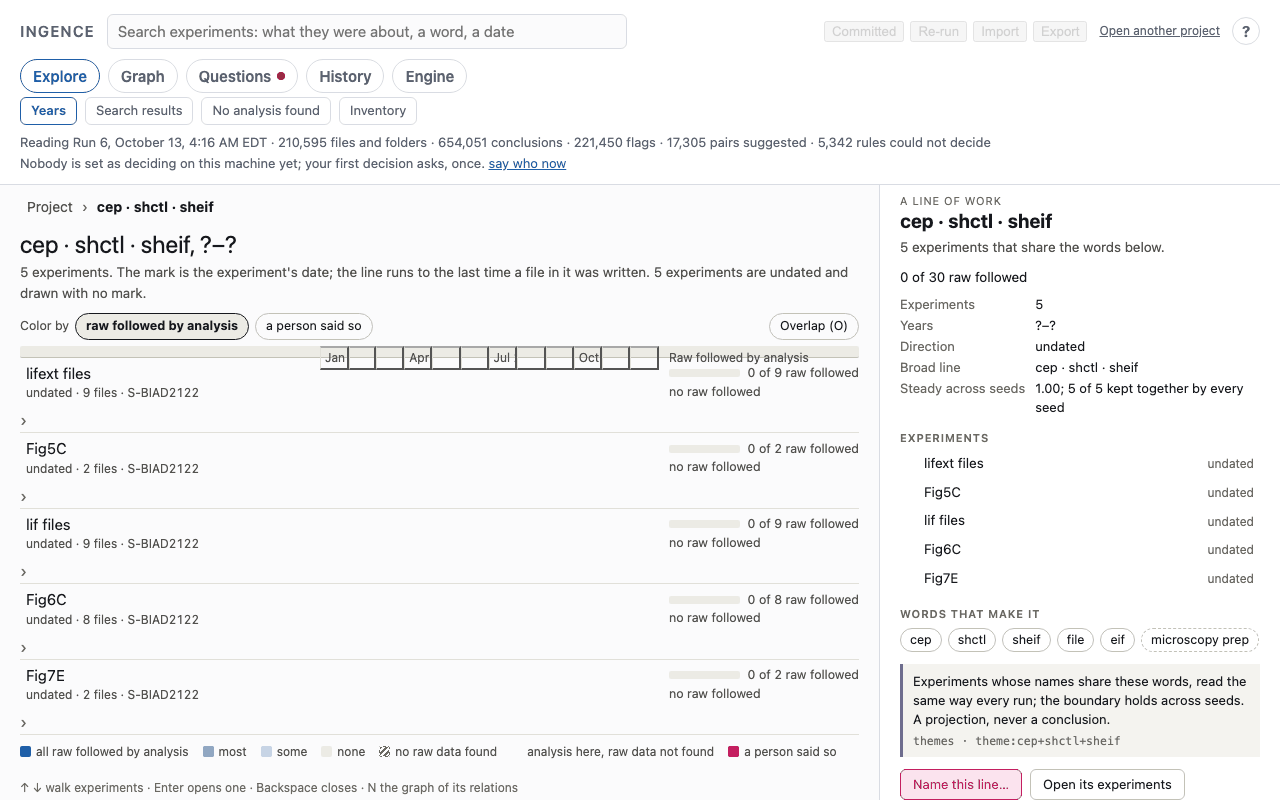
One line of work: five experiments, all from S-BIAD2122. Select the picture to see it at full size.#
What it could not place#
148 of the 1,279 experiments are in no line. 64 have no word to compare. 53 are in a group whose experiments all read the same words, which is no line on its own. 22 have words no closer to any other experiment’s than chance. 6 are in a group too small to be a line, and 3 have words no closer to the rest of their group than chance.
167 of the 263 studies have no experiment the engine could propose.
Dates. 436 of the 1,279 experiments have no date in a name, so they have no place on the Years page’s time axis.
Names#
Across the 263 studies the names hold 493,504 word pieces. The Dictionary gave a meaning to 209,255 of them (42 percent), found nothing for 266,544, and found two or more meanings for 17,705. The 493,504 pieces are 12,108 different words, of which 652 have a meaning in the Dictionary and 11,430 have none. Words such as hoechst, calcein and mcherry have meanings. Many names of genes, strains and cell lines do not.
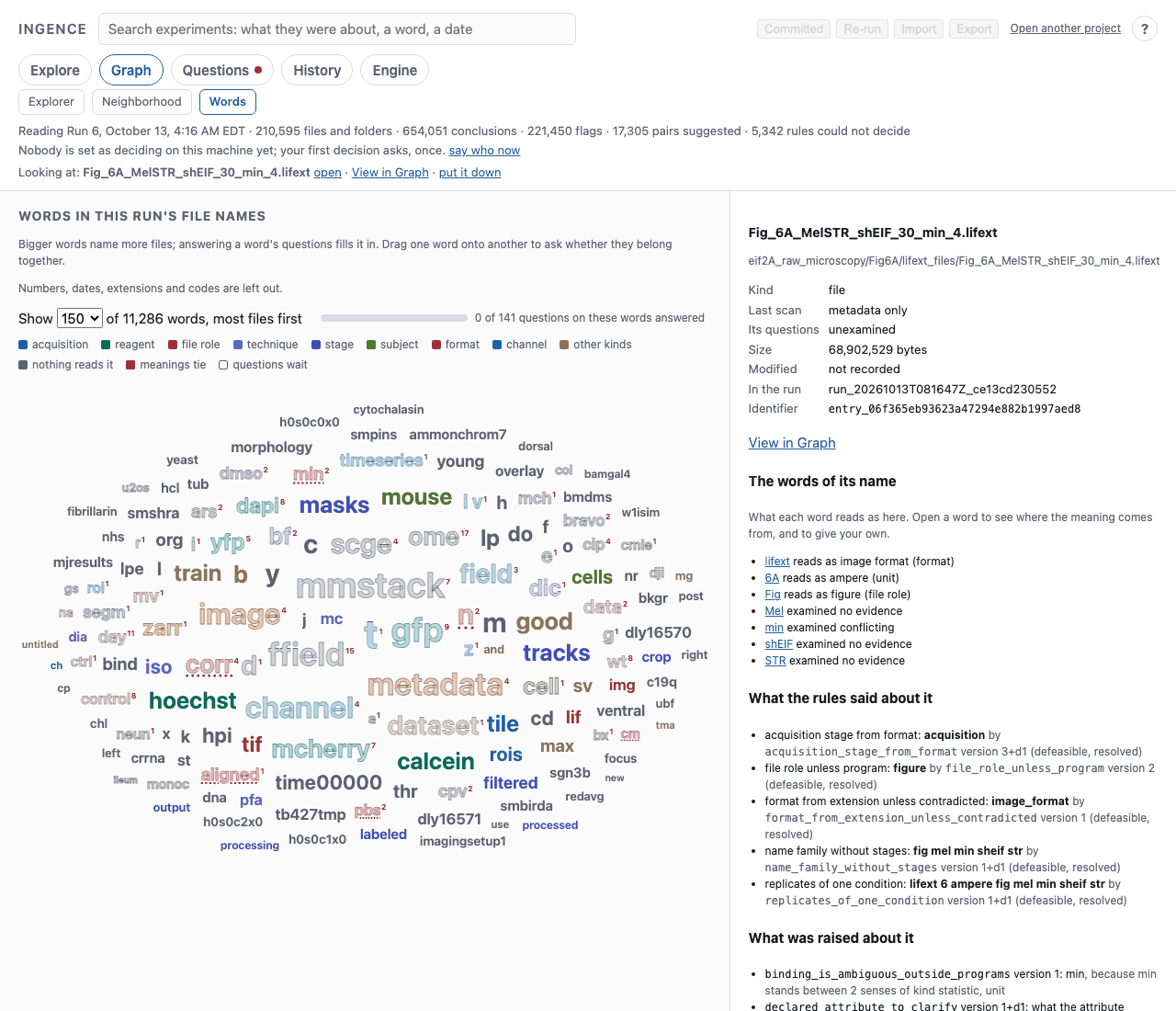
The Words page: the most common words in the file names of all 263 studies. The picture counts 11,286 words, because it leaves out numbers and codes. Words with no meaning in the Dictionary are grey. Select the picture to see it at full size.#
The unit readings seen above recur. Across the project, 611 pieces such as 6A and 5C were read as amperes or degrees Celsius. In 153 of them the name also holds Fig, so they are likely figure panels.
What to make of it#
Everything on the Dashboard for this archive is a proposal made from names, paths and declared sizes. None of it is the archive’s own annotation. The families, experiments and lines of work come from rules you can read, each with a name and a version, and each can be switched off or changed. Where names are written consistently, as with the two conditions of S-BIAD2122, the proposals follow them. Where the Dictionary lacks a word, as with that study’s proteins, the engine says “no evidence”, and where it reads a word wrongly, as with 6A, the reading is wrong in the Dashboard too. The archive’s own datasets were kept out of the rules, so you can compare them with the engine’s proposals, as in the comparison above. Where the two disagree, the depositor’s declaration is the depositor’s statement and the proposal is the engine’s reading of the names.